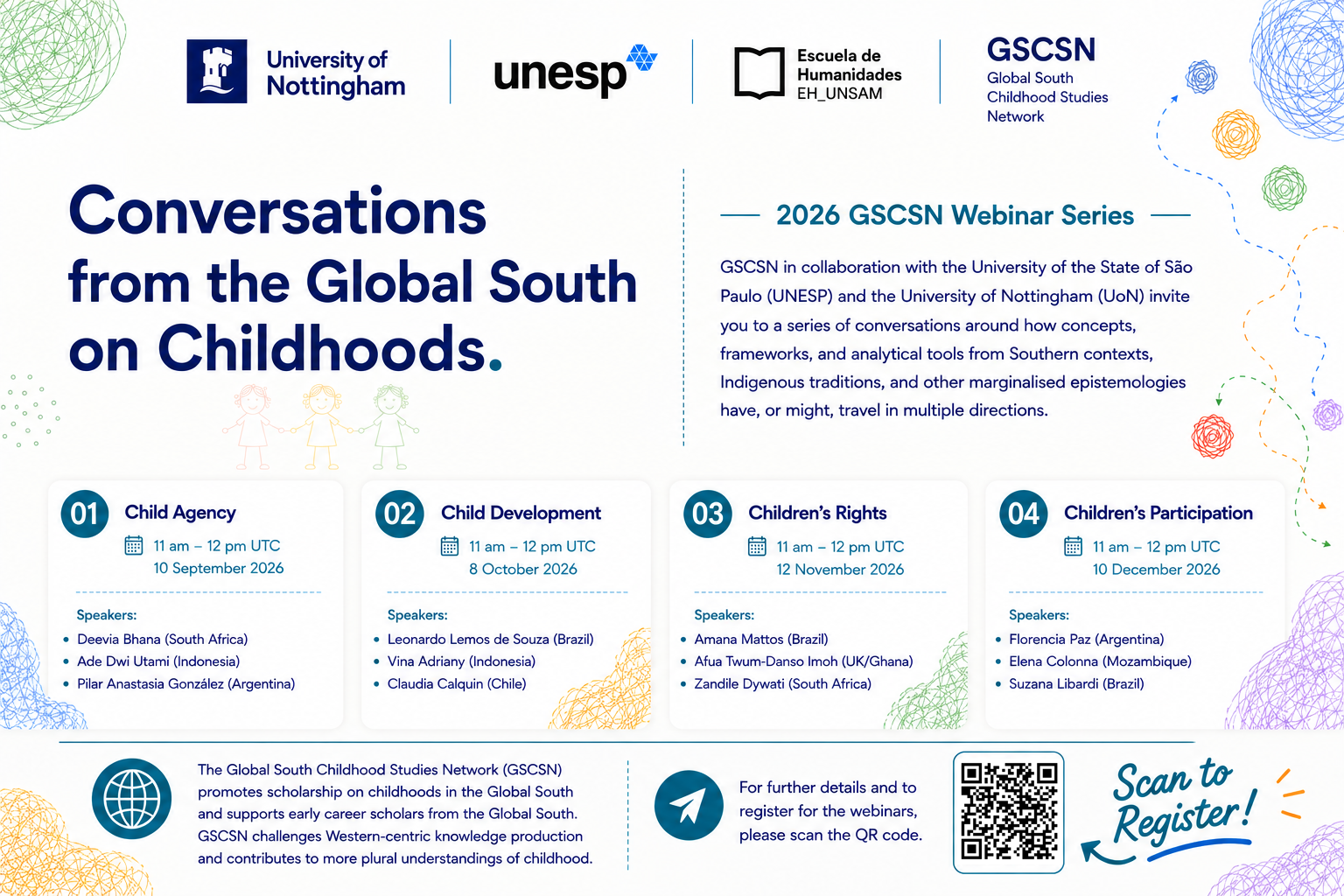
2026 GSCSN Webinar Series
Conversations from the Global South on Childhoods
The webinar series invites a number of conversations around how concepts, frameworks, and analytical tools from Southern contexts, Indigenous traditions, and other marginalised epistemologies have, or might, travel in multiple directions.
September to December 2026
01 / Programme
2026 webinar programme
September to December 2026 · 11:00–12:00 UTC
Child Agency
- Date
- 10 September 2026
Speakers
- Deevia Bhana · South Africa
- Ade Dwi Utami · Indonesia
- Pilar Anastasia González · Argentina
Child Development
- Date
- 8 October 2026
Speakers
- Leonardo Lemos de Souza · Brazil
- Vina Adriany · Indonesia
- Claudia Calquin · Chile
Children’s Rights
- Date
- 12 November 2026
Speakers
- Amana Mattos · Brazil
- Afua Twum-Danso Imoh · UK/Ghana
- Zandile Dywati · South Africa
Children’s Participation
- Date
- 10 December 2026
Speakers
- Florencia Paz · Argentina
- Elena Colonna · Mozambique
- Suzana Libardi · Brazil
02
About the webinar series
Childhood studies have historically drawn on theories from the Global North to interpret children's lives around the world. This has contributed to marginalising Southern epistemologies. To address this scholarly gap, the Global South Childhood Studies Network (GSCSN) offers an inaugural series of four webinars in collaboration with the University of the State of São Paulo (UNESP), the National University of San Martin (UNSAM) and the University of Nottingham (UoN). The Global South Childhood Studies Network aims to promote existing scholarship around Global South childhoods and pushes the field beyond universal and western-centric knowledge about children.
The webinar series invites a number of conversations around how concepts, frameworks, and analytical tools from Southern contexts, Indigenous traditions, and other marginalised epistemologies have, or might, travel in multiple directions. We are interested in how southern traditions destabilize “Northern” developments and how critical studies may help critique the stereotype of the “Theoretical North/Empirical South”. The webinars are designed as a space for conversation, reflection, and exchange by scholars interested in Global South perspectives on the possibilities and challenges of multidirectional conceptual travel in childhood studies.
03
Through the webinar conversations we aim to:
- 01
Explore the politics of conceptual travel and its implications for epistemic justice in childhood research.
- 02
Consider how Southern theories can productively challenge and transform Northern analytical frameworks.
- 03
Reflect on the ethical and practical considerations involved in mobilising / translating concepts across linguistic, cultural, and institutional contexts.
- 04
Engage with methodological strategies, including re-analysis of existing datasets through Southern conceptual lenses.
- 05
Strengthen and expand the network across different disciplines.
04
The politics of theoretical travel
The dominance of Northern theories in childhood studies has been documented (Abebe, Dar & Lyså, 2022; Abebe, Dar & Wells, 2024) as sustaining a largely unidirectional flow of theory. Concepts developed in the Global North like Agency, Children’s Rights, Child Labour, Participation, or Childhood Development travel southward, where they are applied, adapted, or tested. Such a framing carries significant consequences. It embeds certain analytical traditions as the default, constrains debate within pre-validated forms, and renders some dimensions of childhood visible while obscuring others. At its limit, it produces the conditions for epistemic injustice: the uneven distribution of epistemic authority, in which some knowledge-producing communities are systematically positioned as consumers rather than generators of theory (Fricker, 2007).
Yet this picture, while politically important, is itself in need of unpacking. The claim that Southern theorising rarely moves North (Connell, 2007) risks reproducing the very asymmetry it critiques, if taken as a description of what actually happens rather than a critique of what gets recognised. Scholarship on travelling concepts and the vernacularisation of theoretical frameworks — a long-standing concern in anthropology and critical theory — suggests a more unsettled account: that concepts do not travel intact, but are transformed through their uptake in different intellectual and social environments. From this perspective, the supposed predominance of Northern theory is less a straightforward reality than a claim sustained by the politics of citation, journal gatekeeping, and editorial power. Even the most canonically European thinkers — Foucault, Marx, Bourdieu — have been so thoroughly reworked through their encounters with non-European issues that the question of origin becomes analytically secondary to the question of use.
What remains, then, is not simply a problem of centre and periphery, but a problem of recognition: which transformations of theory are acknowledged as theoretical contributions, and which are absorbed invisibly into the apparatus of universal knowledge? This webinar series takes that question as its starting point.
Concepts in Motion
Childhood Studies and the Politics of Theoretical Travel
The series is organised around four core concepts that have structured childhood studies as a field: Agency, Child Development, Children’s Rights, and Participation. Each session takes one concept as its focus, examining not its settled meaning but its career: the conditions under which it was produced, how it has travelled, what it has done in different hands, and what has been lost, gained, or transformed along the way. Participants are invited to present their own engagement with the selected concept: a use, a critique, a partial rejection of, an appropriation, or a reformulation grounded in their own research and intellectual location.
The webinars are organised as situated theoretical conversations, in which the concept itself becomes the object of collective scrutiny. Participants speak from their positions, whether institutional, national or disciplinary. That positionality is part of what is brought into the room, not bracketed out of it.
05
Questions guiding the conversations
To support preparation and give the conversations a shared architecture, each participant is invited to reflect on some or all of the following questions. These are entry points rather than a checklist.
On epistemological politics
What conditions make it possible — or impossible — for concepts developed in Southern contexts to travel and acquire theoretical authority? What institutional, linguistic, and disciplinary gatekeeping do they encounter?
On multidirectional travel
In what ways does this concept challenge, displace, or reconfigure something that was already travelling from the North? Does it replace, complement, or hybridize with Northern frameworks?
On translation and loss
What happens to a concept when it crosses linguistic, social, and cultural borders? What is preserved, what is distorted, and what new meanings emerge through translation and vernacularisation?
On researcher positionality
From where are we speaking, and how does our location — institutional, national, disciplinary — shape what we can see and what we tend to reproduce?
On the Theoretical North / Empirical South divide
How does our own work risk — or actively resist — reducing the Global South to a site of data rather than a site of theory-making?
On ethics and collaboration
What forms of partnership, co-authorship, and intellectual attribution are implied by approaches that take conceptual travel seriously? Who benefits when Southern concepts circulate internationally?
On the field itself
What would childhood studies look like if Southern epistemologies were treated not as regional corrections but as foundational theoretical contributions?
Who is the series for?
This webinar is relevant for researchers, educators, and policymakers interested in decolonising childhood studies, promoting methodological pluralism, and foregrounding Southern epistemologies as sources of theoretical innovation. It is part of the activities of the Global South Childhood Studies Network (GSCSN) in collaboration with the University of the State of São Paulo (UNESP), with a number of invited scholars from different locations across the Global South.
GSCSN focus
GSCSN’s focus is on equality, diversity, and inclusion issues in childhood(s) in relation to children living in underrepresented and/or marginalized contexts, promoting existing scholarship around Global South childhoods. The aim of this series is to capacity-build early career Global South childhood scholars and to explore joint research projects that disrupt dominant constructions of childhood, pushing the field beyond universal and western-centric knowledge about children.
06
Schedule across regions
Second Thursday of each month, September to December
- 8 to 9 am Argentina and Brazil
- 12 to 1 pm UK (then 11-12 Nov & Dec)
- 1 to 2 pm South Africa
- 6 to 7 pm Indonesia
The webinar will be conducted in English.
Presented in collaboration with Global South Childhood Studies Network · University of Nottingham · UNESP · Universidad Nacional de San Martín
GSCSN · 2026
Conversations from the Global South on Childhoods
September to December 2026